A note from Ben. Tammie rode with us in June 2017. We’ve lightly edited her diary for length and taken out details that have changed. A few things are different now: we stay at the Mountaineer Lodge in Lake Louise, and our rental bikes are carbon gravel bikes and e-bikes. For the current itinerary and what’s included, see the tour page.
By Tammie Burak
I had the pleasure of joining Ben Johnson on a Mountain Madness road bike tour from Jasper to Banff along the Icefields Parkway on the second weekend of June. This scenic tour of the Canadian Rockies offers the best of wildlife viewing, glaciers, waterfalls, great food and a chance to make new friends.
Day 1
Nerves, a flat and a grizzly
50 km About 590 m of climbing Route map (opens in a new tab) What you’ll ride past on day 1
My husband Randy and I meet Ben and our trip-mates in Jasper at about noon. We’ll be riding with Jefferey, Karen and Mary. Jefferey and Karen are from Sydney, Australia, and have made this tour part of their western Canada adventure. Mary is a world traveller from Vancouver, on a quest to tick off as many items on her Canadian bucket list as she can. After introductions, we try out the bikes we’ll be riding and make adjustments. Ben puts the pedals I’ve brought on the rental bike I’ll be riding and adjusts the seat for me.
Ready, or not
The rest of the crew look like they’ve been around road bikes all their lives. They’re outfitted in riding gear, complete with cleated shoes. It’s easy to see they’re ready for this.
I, on the other hand, am feeling a little nervous. First of all, it’s raining lightly: not heavy enough for full rain gear, but enough to make me wonder how wet I’ll be by the end of the day. I’m a little concerned about riding with traffic on the mountain highways. And I’m wondering if I can really do this. I know there are some big hills, also known as mountain passes, that I’m not completely sure I’ll be able to climb. And then there’s the distance: roughly 300 kilometres over four days.
Ben swings open the back door of his fully outfitted bike trailer so we can look at the map for day 1. We’ll be riding to Sunwapta Falls and our lodge for the night, Sunwapta Falls Rocky Mountain Lodge. He goes over the route, cautions us about riding too close to the white line and points out our first check stop.
“I’m a little worried about the climbs,” I admit. “I’d hate to make everyone wait.”
“No worries,” Ben says cheerily in his Australian accent. “I’ve got a good feeling about this.”
In a few quick minutes we’re out of Jasper and on the world-famous Icefields Parkway. The profile for this first day is a gradual uphill climb with only one big hill. The mellow start is the perfect way to ease into the daily riding routine and get used to the rental bikes.
Technical support
We haven’t been on the road long when I notice something funny about the way the bike feels. My rear tire has gone flat. Randy grabs the pump attached to the bike and puts air in the tire, and we get rolling again. But a few minutes later, it’s flat again.
“It needs a new tube,” he tells me.
Mary grabs the two-way radio from the case on her bike and radios Ben. There’s no cell reception on this tour except in Jasper and Lake Louise, so Ben provides two-way radios for riders. “Let’s get this tire off,” Randy suggests, “so when he gets here, it won’t take as long to fix.”
While we work the tire off the rim with the tools from the bike’s bag, we keep trying Ben on the radio. Finally, we get a response. It’s crackly, but Ben tells us he’s on his way. When he arrives a moment later, he grabs a wheel with a fully inflated tire already on it and swaps it for the flat one.
Ben puts our bikes in the trailer and drives us ahead so we can ride with the group. The flat has only cost us a few minutes, but the other riders are making good time and it would take us a while to catch them.
The clouds are low, hiding the spectacular views, but at our first rest stop nobody seems too bothered by the weather.
“Marvellous,” Jefferey says, filling his lungs with fresh mountain air as he looks at the glaciers just visible through a break in the clouds. “Just marvellous.” After a brief stop, he and his wife Karen set a brisk pace and quickly pull away from the rest of the group.
Back on the road, we ride for a while before spotting Jefferey stopped on the shoulder just ahead. He’s got his camera out and snaps a photo. We watch with admiration as he hops back on his bike and quickly closes the gap on Karen, who is already cresting the hill in the distance. He’s a powerful rider.
A bear
At the next stop, Karen is excited. “Did you see the bear?” she asks.
While Jefferey was taking our photo, Karen had kept riding, and somewhere on that hill, just off the shoulder of the road, she’d seen a grizzly. It had been eating grass as she passed, but it decided not to stick around for the rest of us and wandered back into the woods.
Ben is waiting for us at the Athabasca Falls viewpoint. He’s got the trailer open and a great spread of snacks laid out: fresh fruit, trail mix and a variety of energy bars and gels, with gluten-free and dairy-free options for those of us who need them. Fresh water comes from a spout on the end of his deluxe grub box. We’ve been riding for a couple of hours and I haven’t eaten since breakfast, so I grab a Clif Bar and some grapes. We’ve got 26 km uphill to Sunwapta Falls, where we’ll stop for the night, and I’m grateful for the chance to refuel.
Sunwapta Falls
A final push uphill gets us to our lodging, the beautiful Sunwapta Falls Rocky Mountain Lodge.
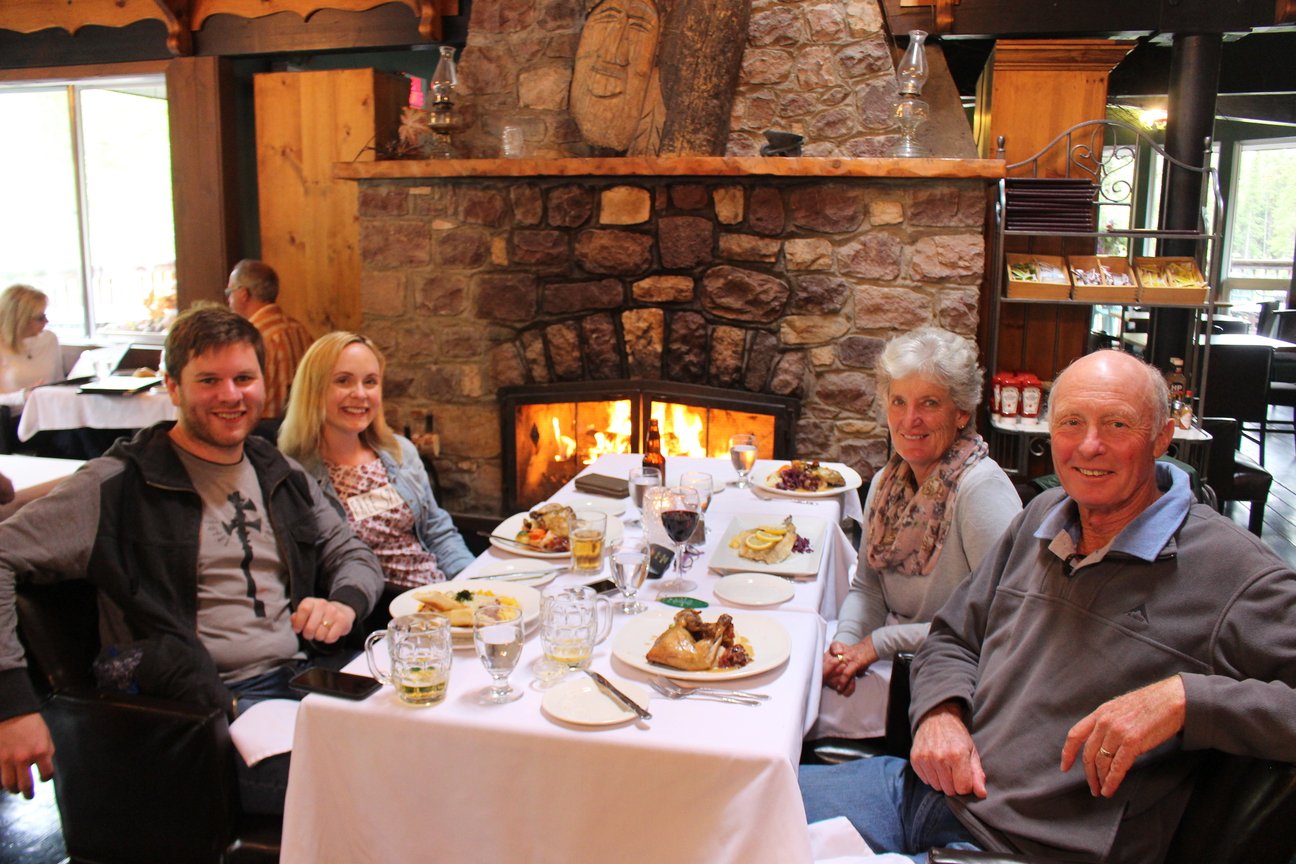
We’ve got time to settle into our rooms, shower and change before supper. Then we walk the short distance to the lodge’s restaurant. Our server fills glasses and sets a tray of steaming loaves on the crisp white tablecloth.
Four of the six of us have special dietary needs, which we told Ben about on our forms when we booked. Still, ordering is a bit of a process, and our server carries questions from our table to the chef and answers back from the kitchen several times before everyone is satisfied. “He’s got the table from hell, hasn’t he?” Jefferey quips in his Aussie accent. But our server’s a gem and never loses his smile.
The three courses are beautifully presented, and the food is every bit as delicious as it looks. The butternut squash soup is a hit at our table, with its rich Asian flavours, a drizzle of garam masala oil and a dollop of thick coconut cream.
After dinner we take a short walk to Sunwapta Falls. There are no daytime tourists around, only our group, and nothing to distract us from the immense power of the water as it rumbles below the bridge across the narrow gorge. We watch a resident raven that seems to make its living gathering goodies from the rocks at the edge of the eddies. It roosts in a crag of the gorge and looks right at home in the mist above the falls.
A plaque at the railing tells us there are 14 species of fish below the falls and only one above, the bull trout. One look at the roiling water as it squeezes into the chute and drops 18 metres (about 60 feet), gouging holes in the rock as it goes, tells you no fish is going to make it up those falls. The plaque suggests that in floods long ago, the ancestors of the bull trout above the falls might have swum past them. Or people may have stocked the river above the falls as a food source. Either way, it’s an intriguing mystery.
Day 2
June snow
98 km About 1,030 m of climbing Route map (opens in a new tab) What you’ll ride past on day 2
There’s snow on the ground the next morning. “Oh, no,” I think. “Not good for riding.” I compare my mountain bike back home in the garage with the road bikes our group is riding. A mountain bike has big knobby tires that handle wet conditions with ease. A bit of snow, even the four or five centimetres (about two inches) we’ve had overnight, wouldn’t be much of a problem for a mountain bike.
A road bike is different. Its narrow, high-pressure tires are smooth and have minimal tread. That means little resistance on the road, making a road bike swift on pavement and a joy to ride on a tour like this in good weather. But riding a road bike on wet roads can be tricky, and today there’s snow and likely ice as well. The snow does not bode well for the day’s ride.
Snow in the Rockies in June
Karen, from Sydney, says she was excited at first to see snow outside her window. But her excitement soon turned to dismay as she thought about what snow would mean for cycling.
Snow in the Rockies in June isn’t unheard of, but it’s rare. “This is the first time we’ve had snow while on tour,” says Ben, and he offers to shuttle the group ahead to a snow-free zone. The riders are game, though, and decide to give it a try.
The profile of the day’s ride is something Ben calls “updulating”: like undulating terrain, but with a more pronounced upward trend. In other words, it’s a steady climb from Sunwapta Falls to the top of Sunwapta Pass.
The wide shoulder has little snow on it at first, but as the elevation rises, so does the snow on the road.
Ben has the van parked at a pull-out near the Glacier Skywalk. The glacier is shrouded in a heavy veil of cloud, and the air is damp and cool. Laughing tourists are throwing snowballs at each other and taking pictures.
Karen and Jefferey are the first of the group to pull up to the van. They seem undaunted by the weather, and after a short stop to pull on some extra clothes, they’re ready to go again.
Our group gets a lot of stares from the tourists. A young man, surrounded by his family, comes over to us.
“We are from China,” he says in good English. “My mother rides a bike at home. Could she please have her picture taken with you?”
Karen graciously poses with the family. The mother puts her hands on the handlebars of Karen’s bike and beams with joy.
“It happens quite often,” Ben explains as the visitors return to their rental car. “People want to have their picture taken with our riders.”
A few minutes later, Mary crests the hill, pushing her bike. “I’m done,” she says with finality. “It’s icy. I’m done.”
Mary does not strike me as someone who gives up easily. A long-distance competitive runner, she’s added this tour to round out her visit and is planning to run the Banff Marathon next weekend. But she’s new to road biking, a steep climb in these conditions is too much, and she knows when to call it quits. She settles into the warm van for the rest of the climb to the lunch stop at the Columbia Icefield.
By noon the snow on the road has melted and the sun begins to shine again. After lunch there are five more kilometres of climbing to Sunwapta Pass, then it’s all downhill to The Crossing Resort, where we’ll spend the night.
Big Bend
A highlight of the downhill stretch is the Big Bend, the hairpin curve that eases the parkway down to the valley floor. The Cirrus Mountain viewpoint over the North Saskatchewan River gives a great view of this spectacular section of road.
Still, the ride down is fairly steep, and the shoulders narrow as guard rails squeeze the road between rock walls and cliffs that drop into the gorge below.
“How did you like the ride down Big Bend?” I ask Jefferey later.
“Great!” he says with a broad smile. “It was really great!”
The Crossing
Flower beds, bright with blossoms, grace the grounds at The Crossing Resort. The nodding daffodils remind me that it’s spring in the Canadian Rockies, and snowy weather can’t last long this time of year. The sky is clearing at the end of the day, and whichever way you look there are stunning views of gleaming snow-capped peaks. Breaks in the cloud promise brighter skies tomorrow.
Day 3
Bears and Bow Summit
83 km About 890 m of climbing Route map (opens in a new tab) What you’ll ride past on day 3
I’m up early the next morning. Breakfast won’t be for another hour, so I stroll the grounds at The Crossing. The motel is set back on a hill, away from the highway and the big restaurant and gift shop.
I love flowers, and I’m admiring the daffodils, tulips and grape hyacinths when I hear a sudden whirr. Rufous hummingbirds, with ruddy backs and iridescent red throats, are jockeying for position at the feeders that hang at the windows. The feeders are a thoughtful touch in this wilderness setting, but I’m amazed the tiny birds are already active in the cold mountain air.
I stroll past the life-size bronze elk in the courtyard in front of the guest lounge and step inside to check the forecast. It’s zero degrees Celsius, but the skies should clear later in the day, with an expected high of 14. Perfect for cycling!
After a filling breakfast, our group meets back at our rooms, where we load our gear in the van and get instructions for today’s ride.
The climb to Bow Summit
The greeting at the top of Ben’s map says, “Good morning, super legends!” I’m not sure I feel like a super legend. To be honest, today is the day that worries me most. Today we climb to Bow Summit, 39 km from The Crossing and pretty much all uphill. The grade isn’t too bad, and I reassure myself with the numbers Ben has marked on the slopes. The worst is 6 percent. I’m not quite sure what that means, but I know it’s less steep than the 8.5 percent of some of yesterday’s climb.
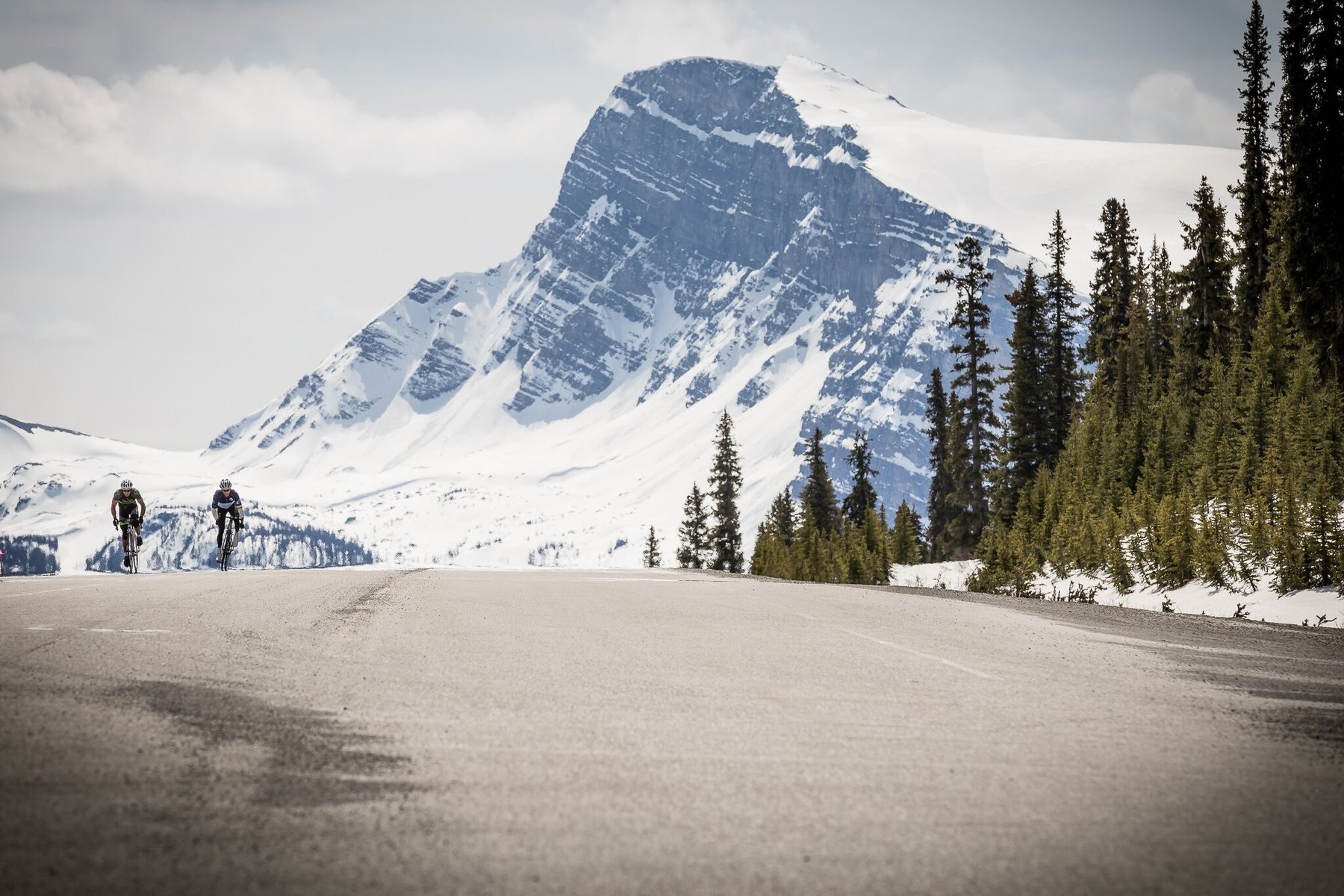
The climbing starts right away, but it’s not too bad. Anyway, I’m completely preoccupied with the stunning views opening up around us as the clouds disperse and the temperature rises. The sun breaks through from time to time, revealing dramatic contrasts between yesterday’s snow, now glistening on the mountains and evergreens, the sombre dark grey rock and the indescribably blue sky. This is what we come to the mountains for.
Bears, bears, bears
As the day improves with each pedal stroke, I start thinking about wildlife. Apart from robins and a raven or two, we didn’t see any yesterday. The animals will likely be moving today. Perhaps we’ll see some sheep.
Then I think: what will we do if we see a bear? I’ve lived in rural areas in different parts of Canada my whole life and I’ve seen lots of bears, but I prefer seeing them from inside a vehicle or a building. A few times I’ve come upon bears while hiking, cycling or running. Except for one occasion, every bear I’ve met has run away.
It’s not the bears that worry me most now. It’s the people around the bears. When bears or other wildlife are spotted along the roads in the mountain parks, drivers pull over on both sides. Although they shouldn’t, people often get out of their cars with their cameras. Some cross the road. Some walk toward the animals, trying for the perfect close-up.
As I’m mulling this over, sure enough, it happens. A car pulls onto the shoulder just ahead of us, and I spot a black bear just off to the right, grazing.
Oncoming traffic pulls over to our left. Cars from behind pull off just ahead of us. Shoulder checking quickly, we slow right down and move into the centre of the lane, watching for opening doors and cars pulling back into the driving lane. All the while, I’m trying to watch the bear out of the corner of my eye.
In no time at all, we’re past it. But this turns out to be our big day for bears: by the end of it, we’ve seen three, up close.
Some time later, while I’m focusing on a crest just ahead and pushing toward it, I catch a glimpse of a massive black shape slightly down and to my right. It’s close, and there are no cars parked at the roadside. Then I hear Mary’s voice just behind me. “Bear,” she says in a low tone. “It’s a bear. It’s big.” The bear looks at Mary briefly and goes back to grazing.
The big, scary Bow Summit climb turns out to be big, but not so scary after all. Ben is waiting at the summit, camera in hand, with a high five for each of us. We turn off the road and ride up to the Peyto Lake viewpoint for what Ben calls the “bonus round.” It’s steep, but because there’s still snow on the ground this early in the season, it’s closed to traffic and far less busy than it will be later in the summer. We admire the turquoise water of Peyto Lake far below and look back down the valley toward the day’s starting point. I have to admit, I’m impressed with how far we’ve come, both across and up.
Lunch at Bow Lake
With Bow Summit behind us, I feel like I can relax. We cruise downhill to our lunch stop at Bow Lake. The food table is laden with goodies, and there are thermoses of steaming hot water for tea. I climb into the trailer and sit on the floor to stretch my quads. Ben’s trailer is a slick set-up, with bike carriers on the wall and a custom-built food table that slides out on rails.
Just then Ben steps past me to fetch some gear from the back of the trailer. He points over his shoulder and asks, “Would you like a yoga mat?” I turn to look. A neatly rolled yoga mat hangs from a hook at the top of the wall. I’m impressed by how well this tour has been organized. Ben has really thought of everything for his guests’ comfort.
The rest of the ride toward Lake Louise is what Ben calls “downdulating”: mostly downhill, with a few of what he calls “whoopsies,” or little bumps. A strong headwind blows against us, and we have the novel experience of pedalling hard to get any speed going downhill. That’s mountain riding.
Our ears have grown used to the sounds of nature: waterfalls and creeks tumbling over boulders, the glassy flute song of the hermit thrush, and the wind playing in the evergreens.
Lake Louise
The cruise into Lake Louise is hugely rewarding. It’s 4:30 in the afternoon, the sun is shining and the robins are singing. The two big passes, Sunwapta and Bow, are behind us, and we’re just 60 kilometres from Banff.
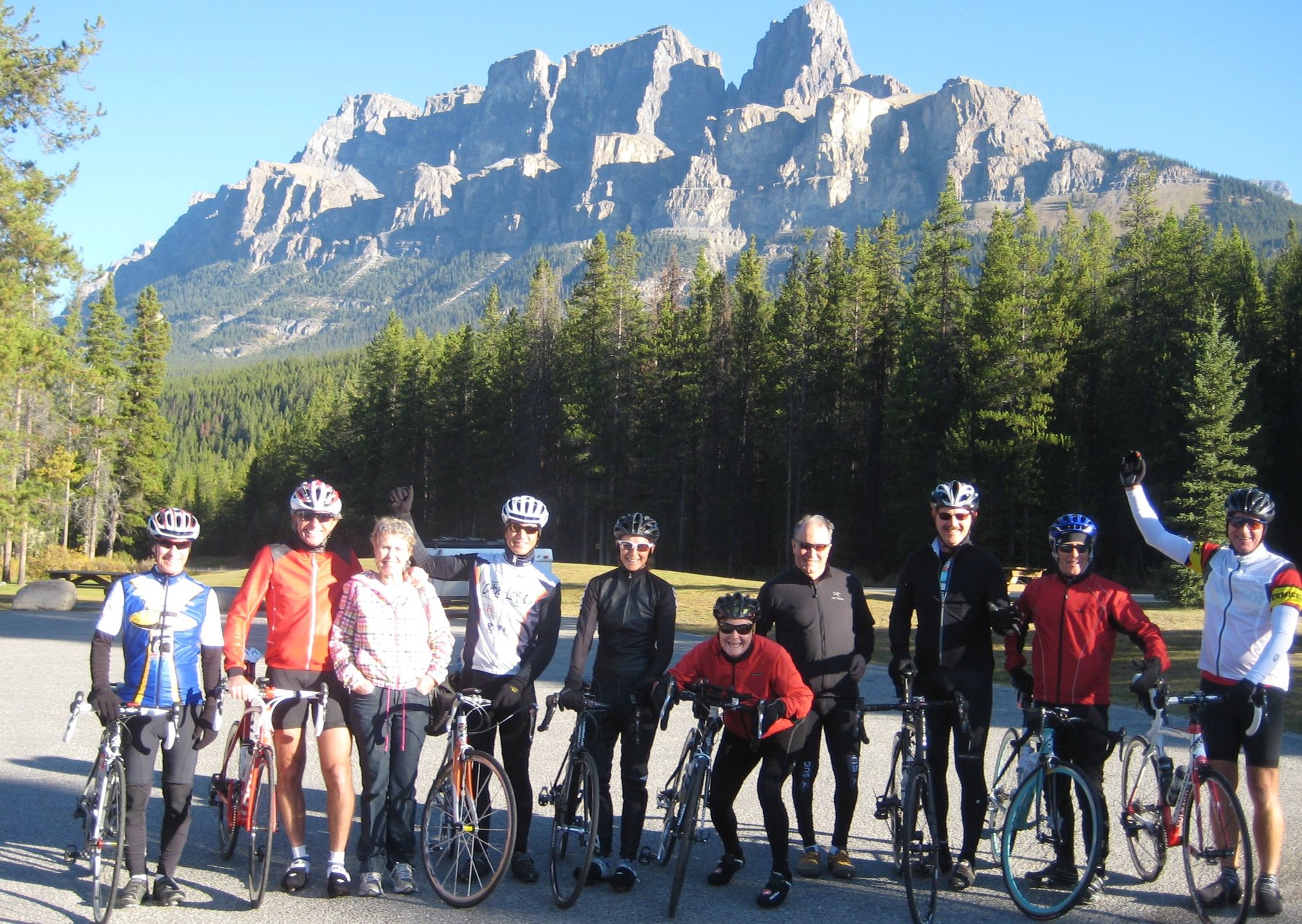
The Mountain Madness van is waiting for us in our hotel’s parking lot. We swing by a mass planting of red and white tulips and drop into big red Adirondack chairs for a group picture.
After dinner, Ben drives the group up to see Lake Louise. There are still lots of tourists milling about when we get there, which isn’t surprising. A trip to the Canadian Rockies wouldn’t be complete without this world-famous turquoise lake and the spectacular peaks that frame it.
Day 4
The Bow Valley to Banff
60 to 85 km About 370 m of climbing Route map (opens in a new tab) What you’ll ride past on day 4
It’s chilly as we head to breakfast at the hotel, but the sky is clear, promising sunshine and warm temperatures.
The breakfast buffet is impressive, with all the fixings for a full western-style breakfast, from sausage, bacon and eggs to waffles, baked goods and lots of fresh fruit. It all looks so good!
Travel plans gone sideways
Back at the table, Ben isn’t eating. Karen has a phone to her ear, and Jefferey is hurrying back to their room for his laptop. They’ve learned just this morning that the airline has cancelled their flight. Their itinerary is full, there’s not much wiggle room, and the atmosphere is tense. Their travel agent is scrambling to rebook them so they reach their next destination on time: Whitehorse, then an Alaskan small-ship cruise. Ben will skip breakfast if he has to, to get them to the Calgary airport for a last-minute flight. Karen gets up and hurries away, the phone still at her ear.
A few minutes later she comes back smiling. Their agent has worked things out. Karen and Jefferey may even have time to ride all the way into Canmore before heading to the airport. They’ll decide once they get to Banff.
The Bow Valley Parkway
In his pre-ride briefing, Ben tells us we’ll take the Bow Valley Parkway into Banff, a scenic route that runs alongside the Trans-Canada Highway. The traffic is light and the shoulder is wide. The peaks soar above the spruce forest that fringes the road. It’s a treat to ride.
The Bow Valley Parkway is one of the best places in Banff National Park to see wildlife. Moose, elk, bighorn sheep and bears are all possible. It would be nice to see some sheep.
But we don’t see any sheep. A spunky but confused chipmunk runs in front of Randy’s bike, gets halfway across the road, then changes its mind and scampers back the way it came.
Later we come upon a gorgeous big elk with enormous velvet-covered antlers. Randy tells us that elk grow a new set of antlers every year. The velvet carries blood to the growing bone and protects the antlers as they grow. Come fall, the elk will rub against trees to strip off the drying velvet and show off his hard, shiny antlers.
We stop at the First World War internment site, which marks where a prison camp held more than 600 men between 1915 and 1917. The memorial plaque tells the embarrassing truth about why some of them were here: “The majority were non-combatants, unemployed civilians: victims of the 1913 depression, racial prejudice and wartime hysteria.”
Life in the camp was very hard. The men worked eight hours a day, sometimes with another five hours of walking to and from the work sites. Their labour helped build the Banff Springs golf course, part of the Bow Valley Parkway, and other national park roads and bridges. The statue of an interned Ukrainian man, his hand held out in a questioning gesture, is a fitting tribute to the shameful history of this place. I wheel away with mixed feelings of remorse and gratitude for those who were so wrongly treated in this beautiful wilderness.
At Castle Junction we peel off some layers, because it’s getting hot. We top up our water bottles and have a snack while Ben shares some news. Six kilometres beyond Castle Junction, the road is closed while crews clear trees that came down in Friday night’s storm. I find out later from a Parks Canada report that more than 100 trees were blown down. We’re thankful for the warning, but sad to leave the beautiful Bow Valley Parkway.
Vermilion Lakes and the finish
Ben reroutes us onto the Trans-Canada Highway. It’s busy and noisy, but the shoulder is wide and there are no hills to climb. We ride single file for about 40 minutes before exiting onto Vermilion Lakes Road. This quiet road is a popular drive from Banff. Benches invite visitors to take in the scenery, sunbathers bask on the docks, and three kayaks ply the shallow water at a leisurely pace, breaking up the reflections of Mount Rundle and Sulphur Mountain.
The air is heady with the scent of blossoming silver willow and balsam poplar as we follow the road into Banff and the end of our tour at the Banff railway station. We stop at the edge of town and pose on and around the Banff sign for a group photo.
At the station we say goodbye to our new friends as they head down the Legacy Trail to Canmore. It’s hard to see them go. As Ben puts away the bike I’ve been riding, he says, “One day they’re all strangers, but by the end of the first day, they’re all best friends.” He’s done this long enough to know that’s just how it is.
We thank Ben for all he’s done to make this an extraordinary tour. We’ve ridden through some of the most outstanding wilderness Canada has to offer on a road bike. We’ve seen grizzly bears, black bears and elk. We’ve touched the clouds, felt the rumble of glacier meltwater rushing toward a distant sea, and breathed some of the freshest, purest air on the planet. And we’ve shared it all with a wonderful group of people who’ve become our friends.
In short, we’ve had an awe-inspiring experience that will stay with us for a lifetime. Thanks, Ben, for an unforgettable Mountain Madness tour!
Jasper to Banff, fully supported
Write your own diary
Four days from Jasper to Banff with hotels, meals, park fees and the van never far away. From $2,697 per person, twin share.