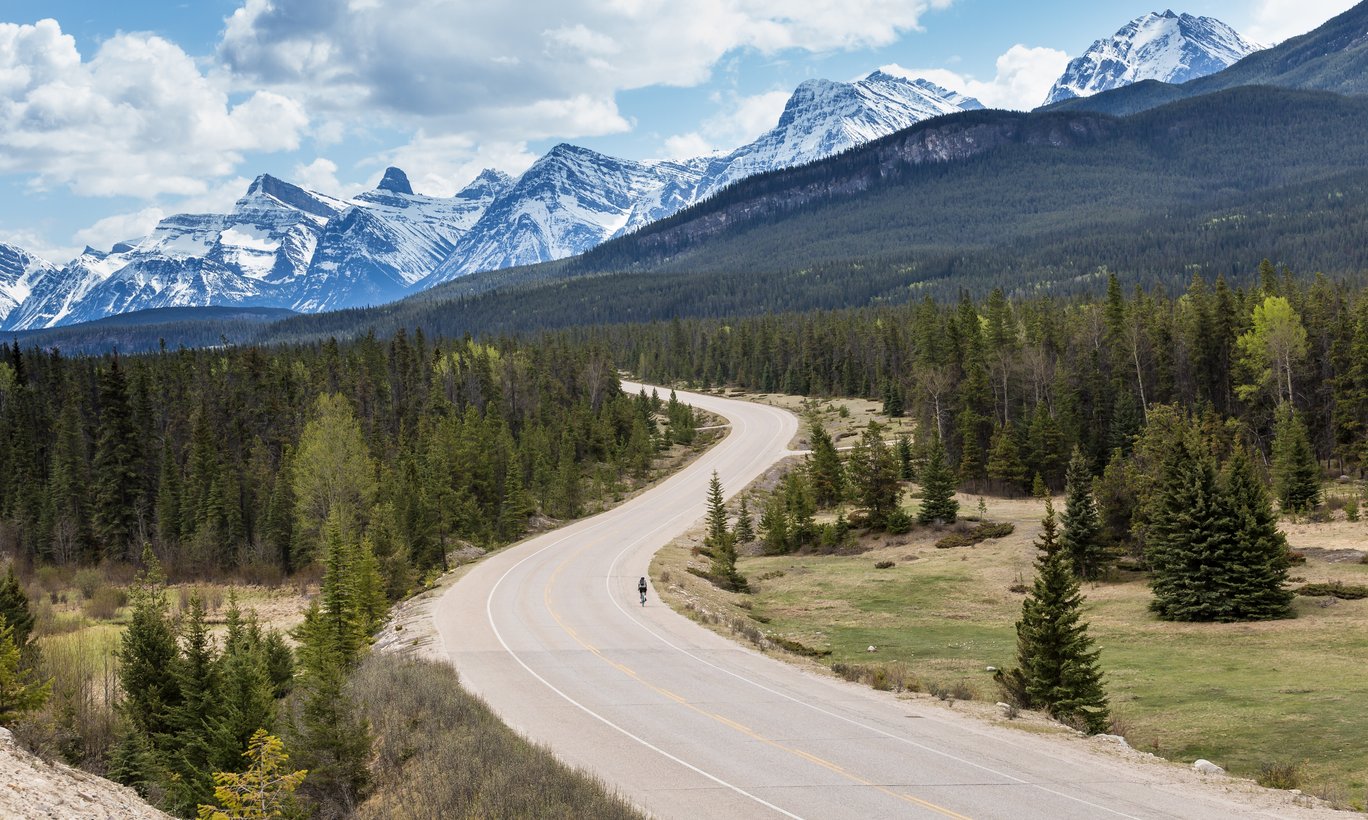
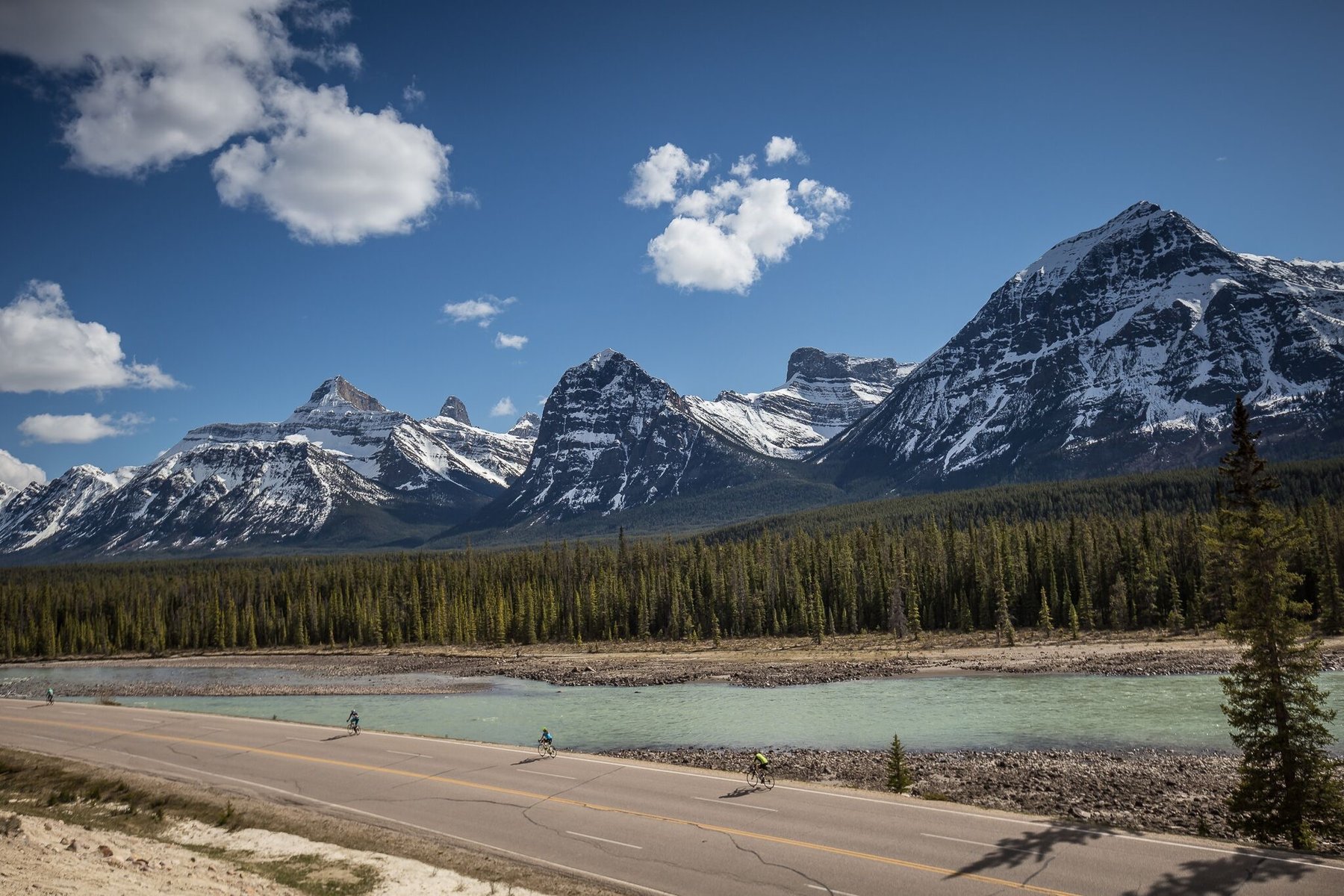
The Icefields Parkway runs 232 km through Jasper and Banff national parks, from the town of Jasper to Lake Louise. It’s the road our tours are built around, and it still stops us in our tracks every summer.
On our four-day tour you ride the parkway from Jasper to Lake Louise over three days, then finish on the quieter Bow Valley Parkway and the Legacy Trail into Banff. That’s 288 km in all, with two passes near 2,000 m.
This page pulls together the facts, a little history, when to go and how the road rides on a bike. For the stop-by-stop detail, see what you’ll ride past, day by day. To hear it from a rider, read a guest’s four days.
Icefields Parkway facts
All figures are from Parks Canada.
- Length
- 232 km, from Lake Louise to Jasper
- Built
- 1931 to 1940, as a Depression-era relief project
- Rebuilt
- The paved, realigned parkway opened in 1961
- Highest point
- 2,070 m, near Bow Summit
- Sunwapta Pass
- 2,035 m, the boundary between Jasper and Banff national parks
- Columbia Icefield
- More than 300 square kilometres of ice
- Visitors
- More than 1.2 million a year, mostly in summer
- Cell service
- None on most of the road; limited at the Columbia Icefield in summer
How the road was built
Long before there was a road, this was a route on foot and by pack horse. By the early 1900s outfitters and climbers were travelling the valleys between Lake Louise and Jasper on a pack trail known as the Wonder Trail.
Construction of a highway along it began in 1931, as a Depression-era relief project. Parks Canada’s history of the parkway says it took 600 men nearly ten years. They did most of the work by hand, with horse teams pulling the graders and plows and one small tractor in each camp. The result, finished in 1940, was a single-lane gravel road.
Traffic grew after the war, and a new, paved and realigned Icefields Parkway officially opened in 1961. That’s essentially the road we ride today, with a wide shoulder along about 90 percent of our route.
Biking Jasper to Banff with us
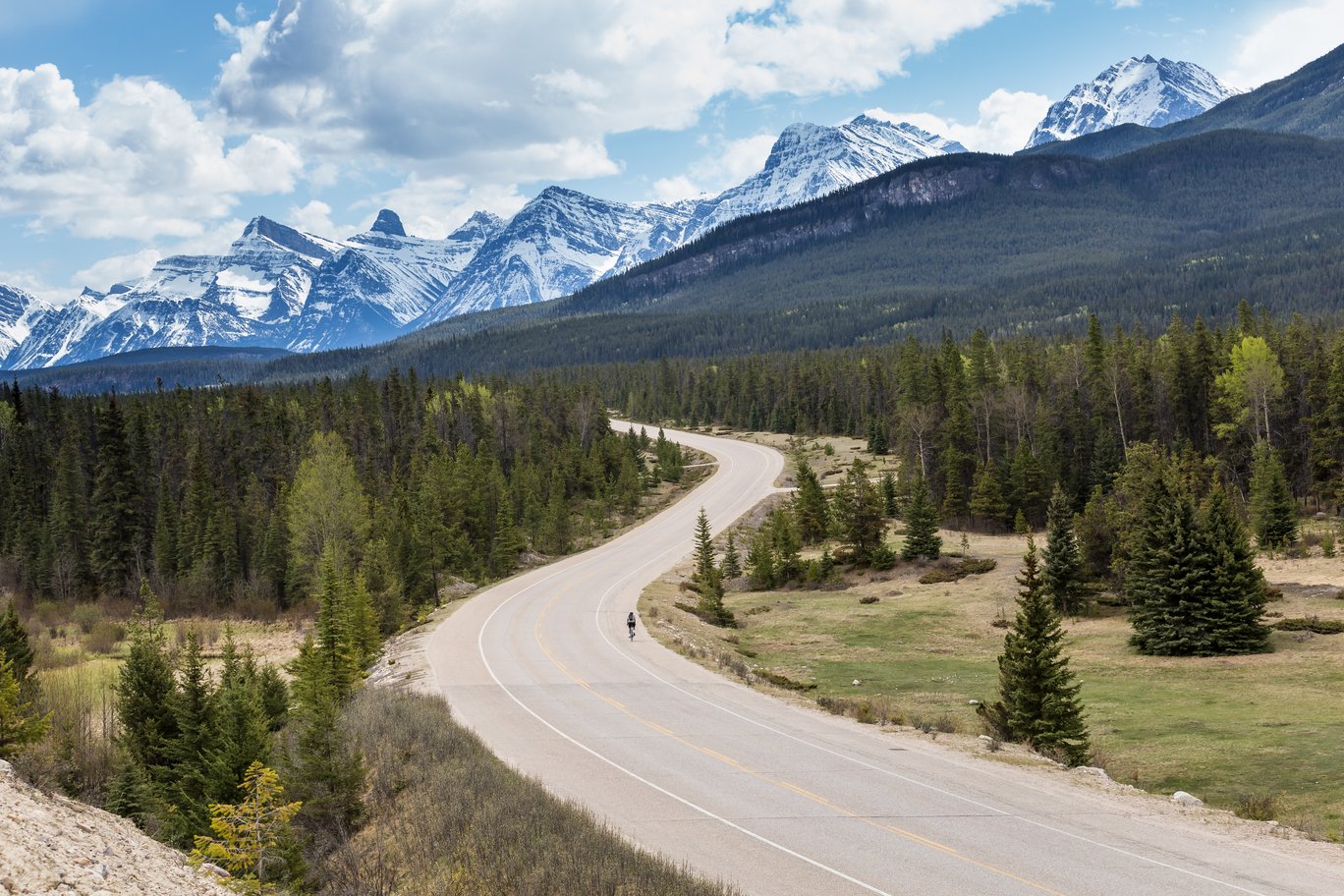
Our scheduled tour picks you up in Edmonton on the first morning and rides from Jasper that afternoon. Here’s how the four days break down, with links to the detail for each.
-
Day 1: Edmonton to Jasper, then ride to Sunwapta Falls
50 km · about 590 m of climbing
Pickup at about 8 am, a half day in the van to Jasper, then the first afternoon on the Icefields Parkway to Sunwapta Falls Resort.
-
Day 2: Sunwapta Falls to The Crossing
98 km · about 1,030 m of climbing
The big one. Past the Athabasca Glacier and over Sunwapta Pass, then a long descent past the Weeping Wall to The Crossing Resort.
-
Day 3: The Crossing to Lake Louise
83 km · about 890 m of climbing
A steady climb to Bow Summit, the highest point on the parkway, then downhill past Peyto, Bow and Herbert lakes to the Mountaineer Lodge in Lake Louise.
-
Day 4: Lake Louise to Banff
60 to 85 km · about 370 m of climbing
Rolling hills on the quiet Bow Valley Parkway and the Legacy Trail into Banff, on to Canmore if the group wants, then the drive home via Calgary.
Icefields Parkway stops on our route
The van leapfrogs the group all day and waits at pull-outs about every hour. These are the stops we use most, in riding order. The exact stops change with the weather and the group.
For the whole road on one page, download Parks Canada’s Icefields Parkway map (PDF, 0.5 MB).
Day 1
- Whirlpool Valley viewpoint, under Mount Hardisty
- Athabasca Falls, our first rest stop
- Goats and Glaciers viewpoint
- Sunwapta Falls, an evening walk from the lodge
Day 2
- Jonas Creek rockslide
- Mushroom and Diadem peaks viewpoint
- Tangle Falls
- Stutfield Glacier viewpoint
- The Columbia Icefield and the Athabasca Glacier, for lunch
- Sunwapta Pass
- Parker Ridge pull-out
- Big Bend and the Weeping Wall
- Saskatchewan River Crossing
Day 3
- Mistaya Canyon
- Waterfowl Lake, under Mount Chephren
- Bow Summit and the Peyto Lake viewpoint
- Bow Lake, for lunch
- Hector Lake viewpoint
- Lake Louise
Day 4
- Storm Mountain viewpoint on the Bow Valley Parkway
- Castle Mountain, our last rest stop
- Vermilion Lakes and the Legacy Trail
- Banff, or on to Canmore
When to ride
Our tours run from early June to mid-September. July and August are the busiest months, and we book our hotels more than a year ahead, so it pays to book early.
Mountain weather changes fast, whatever the month. Rain in the valleys can mean snow on the passes, and one of our June groups woke to a few centimetres of snow at Sunwapta Falls. You can read how that day went in the guest diary. Pack for cold mornings and warm afternoons, and bring a jacket even when the forecast looks good.
Road notes for cyclists
- The shoulder. It’s wide along most of the route. Where it narrows, such as on the Big Bend descent below Sunwapta Pass, ride single file and keep to the middle or right side of the shoulder.
- No cell service. Parks Canada notes there is none on most of the parkway, apart from limited coverage at the Columbia Icefield from May to early October. On our tours every rider carries a two-way radio and the van carries a satellite communicator.
- Few services. Fuel and food are scarce between Jasper and Lake Louise, and the services at Saskatchewan River Crossing open in summer only. We carry the water, food and spares.
- Wind. Expect a cool headwind off the glaciers near the Columbia Icefield, and some afternoons a headwind even on the downhills.
- Wildlife. Cars stop for animals, often on both sides of the road. Slow down, watch for opening doors and keep moving. More on that below.
- Park pass. Parks Canada requires one on the Icefields Parkway. On our tours, park fees are included.
- The Bow Valley Parkway. Our last day follows this 48 km road between Lake Louise and Banff, a quieter alternative to the Trans-Canada Highway. In spring and fall Parks Canada has been running a cycling pilot that closes its 17 km eastern section to cars, so check their page for current dates if you ride outside summer.
Wildlife along the route
Some of the most photographed animals on the parkway are the smallest. At pull-outs and rest stops you’ll meet little striped rodents hoping you’ll drop a crumb, and riders always ask: is it a chipmunk or a squirrel?
Look at the face. A least chipmunk is small and quick, with stripes running through its face as well as down its back. A golden-mantled ground squirrel is bigger, with a tawny to reddish “mantle” over its shoulders, a white stripe edged in black down each side, and no stripes on its face. Parks Canada says the ground squirrels are often mistaken for chipmunks.
Ravens hang around the rest stops too. A raven is bigger than a crow, about the size of a red-tailed hawk, with a heavier, curved bill and shaggy throat feathers. In flight its tail is wedge-shaped where a crow’s fans out, and it soars where a crow flaps. Crows caw; ravens croak.
The bigger animals are the ones people hope for. Parks Canada lists elk, moose, deer, bighorn sheep, mountain goats and black and grizzly bears among the animals you may see. Our Goats and Glaciers stop on day one is named for the mountain goats that visit it, and bighorn sheep are often seen on the Wilcox Pass trail near the Columbia Icefield.
Whatever you see, give it room and never feed it. Parks Canada asks you to stay at least 30 m from elk, deer, sheep and moose, and 100 m from bears, wolves, cougars and coyotes. Feeding, enticing or disturbing wildlife is illegal in a national park, with fines up to $25,000, and that includes the chipmunks and squirrels. If a wildlife jam builds up, take a look and ride on.
Jasper to Banff, fully supported
Ride it with us
Four days from Jasper to Banff with hotels, meals, park fees and the van never far away. From $2,697 per person, twin share.